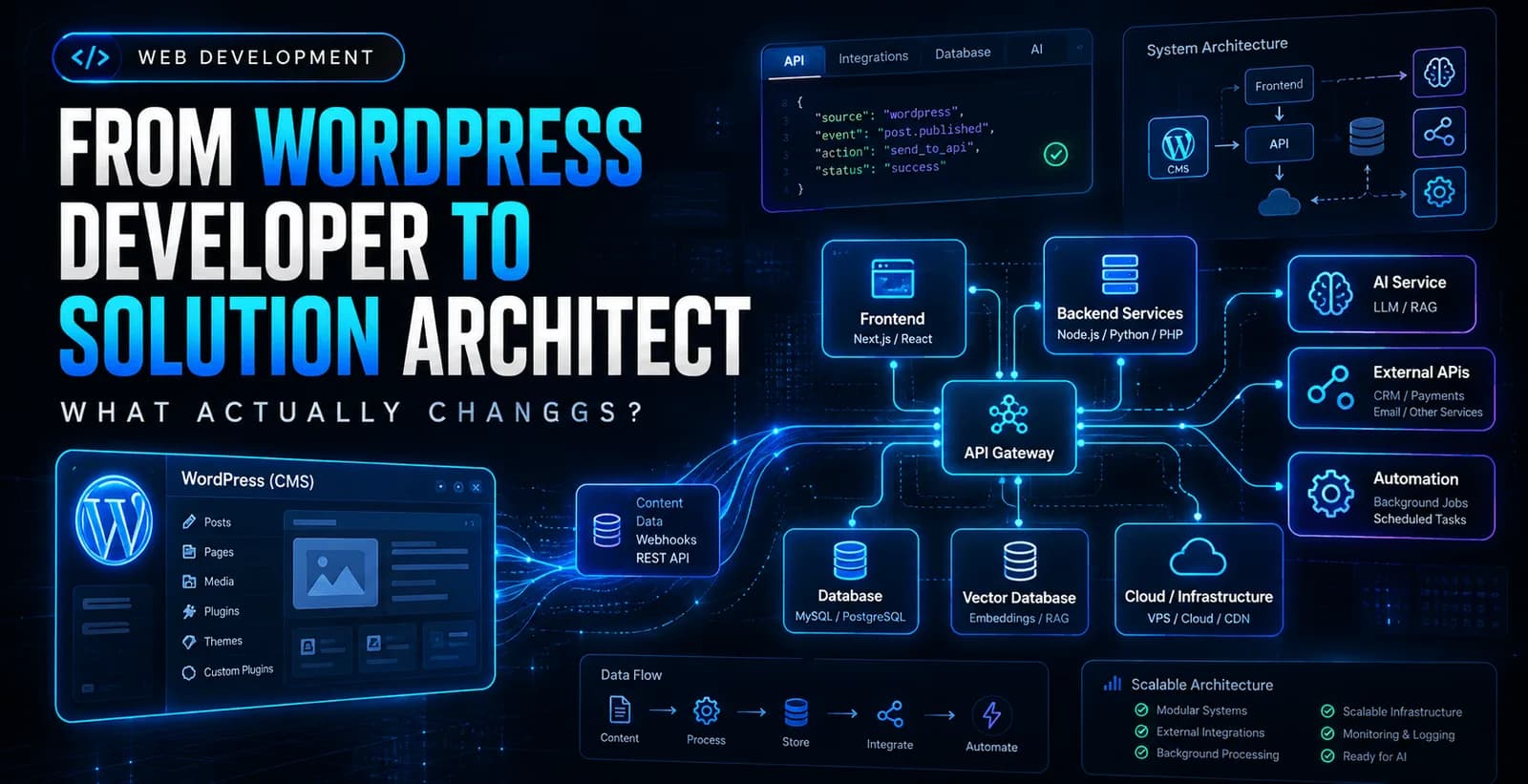
For a long time, being a WordPress developer can mean thinking primarily about the website in front of you. A new feature needs to be built, a custom plugin needs to be created, an API needs to be connected, or a database query needs to be optimized.
As projects become more complex, however, the questions start changing.
Instead of only asking “How do I build this?”, you start asking “Where should this functionality live, how should the systems communicate, and what happens when something goes wrong?”
That shift is one of the biggest differences between being focused on implementation and thinking like a solution architect.
WordPress Is Often Where the Journey Starts
WordPress can look simple from the outside because a basic website can be created without much development work. But once you start building custom functionality, the platform exposes you to many areas of software engineering.
Custom plugins require PHP and database knowledge. Complex websites involve APIs, authentication, caching, scheduled tasks, custom database tables, JavaScript, third-party services, and performance considerations.
Eventually, a WordPress project can become much more than a CMS.
You might have WordPress managing content while a separate application handles business logic. A CRM may store customer information, an external service may process payments, and another system may handle email or inventory.
At that point, the developer is no longer working on an isolated website.
They are working on a system of connected components.
The Question Starts Changing
Early in development, a requirement might sound straightforward:
“We need to connect the website to our CRM.”
The implementation-focused question is:
“Which WordPress plugin can connect to the CRM?”
That can be a perfectly reasonable place to start.
But as the requirements become more serious, more questions appear.
What data should be sent to the CRM? Which system is the source of truth? Should the integration happen immediately or in the background? What happens if the CRM is unavailable? What happens if the same event is received twice? How should authentication work? How should failures be retried?
Now you're no longer simply choosing a plugin.
You're designing an integration.
That is where architectural thinking starts to become important.
From Features to Systems
A developer is often focused on making an individual feature work.
A solution architect has to consider how that feature fits into everything around it.
Imagine a property management platform that needs to connect landlords, tenants, suppliers, payments, notifications, and reporting.
The problem isn't simply deciding how to build each screen.
You need to think about where the data lives, which application owns each piece of information, how services communicate, how users are authenticated, how background operations run, and how the system behaves when one component becomes unavailable.
The architecture might look something like this:
                    Users
                      |
                Web Application
                      |
                Backend / API
                      |
        +-------------+-------------+
        |             |             |
    Database       External APIs   Background Jobs
        |             |             |
        +-------------+-------------+
                      |
                Business Logic
The technologies can change, but the architectural questions remain.
WordPress Doesn't Have to Do Everything
One of the most important lessons is that choosing WordPress doesn't mean every piece of functionality has to live inside WordPress.
WordPress can be excellent at managing content while another application handles specialized business logic.
For example:
                    Website
                       |
                 Next.js Frontend
                       |
                    Backend
                  /    |     \
                 /     |      \
          WordPress   Database   AI Service
             |                    |
          Content              LLM / RAG
In this architecture, WordPress is still valuable. It may remain the content management system while the rest of the platform handles responsibilities that don't belong in the CMS.
This way of thinking also makes it easier to evaluate technologies objectively.
The question becomes less about “Can WordPress do this?” and more about “Should WordPress do this?”
Those are very different questions.
Choosing the Right Tool Becomes More Important
As developers gain experience, technology choices become less about what can be built and more about what should be built.
A plugin might solve a requirement quickly, but it may introduce unnecessary dependencies.
A custom plugin might provide more control, but it creates additional code that needs to be maintained.
A separate service might provide better isolation, but it also introduces another application to deploy and monitor.
A headless architecture might provide frontend flexibility, but it also means managing separate frontend and backend systems.
There is rarely one universally correct answer.
Architecture is largely about understanding these trade-offs and choosing the solution that makes sense for the actual business requirements.
APIs Change the Way You Think About Applications
Working with APIs is another point where the boundaries of a traditional WordPress project start to disappear.
Once an application communicates with multiple systems, you have to think about data contracts, authentication, rate limits, timeouts, retries, validation, and versioning.
You also start thinking about whether communication should happen synchronously or asynchronously.
For example, sending information to another system doesn't always need to happen during the user's request.
A webhook or background job may be more appropriate:
User Action
    |
    v
Application
    |
    v
Create Event
    |
    v
Queue / Background Job
    |
    v
External Service
This can make the application more resilient because the user-facing request doesn't necessarily depend on the external service responding immediately.
These decisions are not specific to WordPress.
They are general software architecture problems.
The Database Becomes Part of the Architecture
Another major shift happens when you stop thinking about the database as simply the place where WordPress stores content.
Different applications may need different types of data.
A traditional relational database might store users, orders, permissions, transactions, and application state. A vector database might store embeddings for semantic retrieval in an AI system.
The important question becomes:
What kind of data are we dealing with, and what kind of access does the application need?
That is a much broader question than simply deciding whether to use MySQL or PostgreSQL.
Good architecture starts with understanding the data and the workload before choosing the technology.
Then AI Becomes Another Part of the System
This is where the move from traditional web development into AI engineering starts to make more sense.
An AI application isn't simply an API call to an LLM.
A production system might look like:
User
  |
Frontend
  |
Backend
  |
  +---- Traditional Database
  |
  +---- Vector Database
  |
  +---- RAG
  |
  +---- External Tools / APIs
  |
  +---- Guardrails
  |
  +---- Observability
  |
  v
LLM
The model is only one component.
The application still needs authentication, business rules, data access, validation, error handling, security, monitoring, and infrastructure.
This is why the transition from full-stack development into AI engineering isn't as disconnected as it might initially appear.
The technologies are different, but many of the engineering principles remain the same.
The Shift From Coding to Decision Making
The biggest change isn't necessarily learning another programming language or framework.
It is learning to think about decisions and consequences.
A developer might ask:
“How do I implement this?”
A solution architect asks:
“What is the simplest architecture that solves this problem reliably?”
That second question forces you to consider more than implementation.
You have to think about security, scalability, performance, cost, maintainability, failure scenarios, operational complexity, and future requirements.
Sometimes the correct architectural decision is to build something.
Sometimes it is to use an existing service.
Sometimes it is to keep the functionality inside WordPress.
Sometimes it is to move it into a separate application.
And sometimes the best decision is to not build the feature at all.
You Don't Really Leave WordPress Behind
Moving from WordPress development toward full-stack engineering, solution architecture, or AI doesn't mean the previous experience becomes irrelevant.
In fact, working deeply with WordPress can provide a strong foundation.
It teaches you how real businesses use software, how requirements change, how integrations fail, how plugins create dependencies, how databases behave, how users interact with systems, and how technical decisions affect maintenance.
Those lessons continue to matter when the stack changes.
The difference is that the scope becomes larger.
You might start by building a WordPress plugin, then find yourself designing an API around it. Later, you may build a separate frontend, introduce background workers, connect multiple databases, automate business processes, or add an AI service.
The problem keeps getting bigger, while the underlying engineering principles remain familiar.
The Real Transition
Moving from WordPress development to solution architecture isn't about abandoning WordPress.
It is about changing the level at which you solve problems.
You start by thinking about pages and features. Then you start thinking about applications and integrations. Eventually, you think about systems, boundaries, data, dependencies, and trade-offs.
WordPress can be part of that architecture. So can React, Next.js, Node.js, PostgreSQL, cloud infrastructure, automation platforms, or AI services.
The technologies are tools.
The real skill is knowing where they belong, why they belong there, and how the entire system should work together.
That is ultimately what changes when you move from being focused on WordPress development to thinking like a solution architect.